
Patient Education
Partial Denture for One Missing Tooth
When a patient has a single missing tooth or needs only one tooth extracted, there are multiple replacement options. For many patients, a partial denture is one of the leading options. Partial dentures for one missing tooth are removable dental appliances that hook onto a patient’s natural teeth and contain a prosthetic tooth mounted in pink resin to match the patient’s gums.
Partial dentures for one missing tooth are available at Baseline Dental Practice in Rancho Cucamonga and the surrounding area. If you are ready to get your missing tooth replaced, call us today at (909) 987-7676 to schedule an appointment.

Partial Removable Dentures
When a tooth is missing, the other teeth move and fill the space. They do not do this evenly, meaning this movement makes things worse. It also becomes more difficult to bite or chew with a missing tooth.
Depending on the patient’s needs, replacing a missing tooth with a prosthetic can be a good way to help keep the entire mouth healthy. Having a full set of teeth, natural or not, also improves a person’s smile. Partial removable dentures is a tooth-replacement option that can be used for only one missing tooth, in place of an implant or prosthetic.


Process of Getting Partial Dentures
As explained by WebMD, a removable partial denture is contoured to fit snugly into the patient’s mouth. To get this custom fit, Baseline Dental Practice takes impressions of the mouth before having the denture made. The finished product consists of pink resin and one or more prosthetic teeth.
Although the partial denture may feel tight and uncomfortable at first, most patients get used to it in a matter of weeks. A partial denture can help with chewing but should be removed for sleep. It is important to keep the apparatus scrupulously clean to avoid problems with bacteria.
Pros and Cons of Partial Dentures for One Missing Tooth
Using a partial denture to fill a space left by a missing tooth has its advantages and disadvantages. Always consider the advice of your dental professional when deciding whether or not to replace a tooth. Depending on the patient’s oral health, the ability to maintain dental hygiene, and other circumstances, a partial denture may or may not be the right option.
Pros:
- Lower cost than implants
- Easy to get used to
- Less time to fabricate
- Maintains appropriate spacing of teeth
Cons:
- Uncomfortable at first
- Not as durable as an implant or bridge
- May require periodic adjustment or repair
If you are unsure of what your best options are, contact our office to schedule an appointment today. Baseline Dental Practice can conduct a comprehensive oral exam to determine an individualized care plan for you.


Other Options for Replacing a Single Missing Tooth
A partial denture is a quick, common solution for replacing a tooth, but there are alternatives. The treatment chosen depends on the patient’s situation and needs. When a replacement tooth is required, several choices are available:
- Implants. Dental implants are part of a long-term solution for missing teeth. A dentist can place implants in a patient’s jaw and attach false teeth to them. They are incredibly durable and, according to the American Academy of Implant Dentistry, may help prevent bone loss around a tooth extraction. However, implant placement is more invasive than getting a partial denture. Depending on the type of implant, it may be several months before the final installation of the prosthetic tooth.
- Bridges. A dental bridge consists of a group of crowns that attach to healthy teeth on either side of the gap. It is necessary to reduce the healthy teeth that will support a bridge to allow crowns to go over them. The three or more crowns that make up the dental bridge are a single piece with no way to floss between them. Additionally, extra care is needed to clean under the pontic, or part that fills the gap.
- A combination of solutions. Implant-supported bridges are an option for those without the necessary natural teeth. Similarly, implant-supported dentures, which can replace the entire upper arch, lower arch, or both, are also an option for some people. Implants last a long time with proper care, but they do sometimes fail. Because dental implants fuse to the jawbone and require good overall health to ensure healing, not every patient is a candidate.
Real Results
Before & After
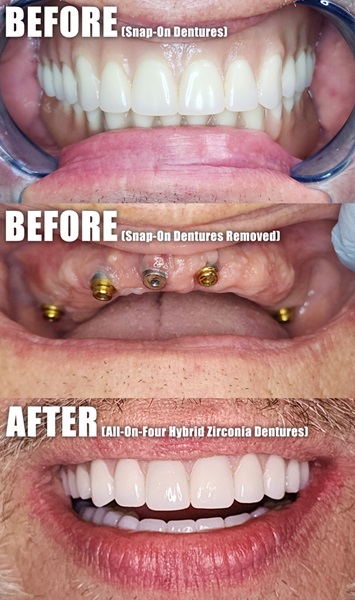
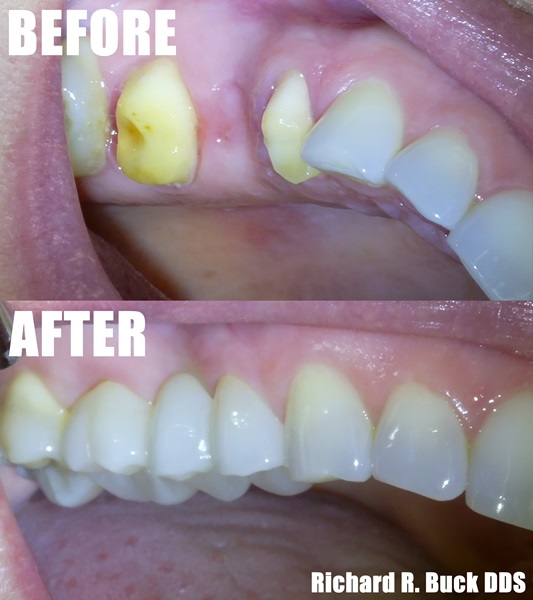
A few results from real Baseline Dental patients.

Frequently Asked
Common Questions
Have a question we did not answer here? Our team is happy to help you understand your options.
Are partial dentures for one missing tooth cost-effective?
Partial dentures are often more affordable than implants or fixed bridges. However, because they are not as durable as other prosthetic teeth, there may be ongoing expenses. Cost alone should not be the determining factor when considering tooth replacement options. Consult with Baseline Dental Practice to determine the right choice for you.
Is it worth it to use partial dentures for one missing tooth?
When a tooth is missing, other teeth begin to shift inside the mouth. This shifting affects the bite and, according to the U.K.-based Oral Health Foundation, may also contribute to tooth decay. Another symptom of missing teeth is bone loss. Fortunately, both these side effects may be able to be minimized depending on the type of replacement tooth.
Should I choose implants or partial dentures for one missing tooth?
Each patient’s oral health, medical history, and overall physical condition play a role in determining the option for replacing missing teeth. Other important factors include the position of the missing tooth, affordability, and insurance coverage. Consult with a qualified professional before making this decision.
Are there advantages to getting partial dentures for one missing tooth?
Partial dentures tend to cost less than implants and bridges. They also generally take less time for design, creation, and placement. They are easy to insert, remove, and clean.
Are dental bridges a good option instead of partial dentures for one missing tooth?
Dental bridges tend to be strong and durable. Whether they are a good option depends on the condition of the surrounding teeth and the patient’s overall oral health. When chosen to replace missing teeth, dental bridges can last many years with proper care.
What is the difference between partial dentures for one missing tooth and a flipper?
They are the same thing. A partial denture is also often referred to as a partial. Less frequently, it is called a plate or a dental plate.
Learn More About Partial Dentures
Partial dentures are a relatively easy way to restore your smile quickly. They also provide some of the functions of your missing teeth. If you are ready to get started with this treatment for your missing tooth, call us today at (909) 987-7676.
Glossary
Denture Terminology
Alveolar Bone
The alveolar bone is the bone surrounding the root of the tooth that keeps the tooth in place.
Clasp
A clasp is a device that holds a removable partial denture prosthesis to the teeth.
Denture Base
The denture base is the part of the denture that connects the artificial teeth with the soft tissue of the gums.
Edentulous
Edentulous is a term that applies to people who do not have any teeth.
Periodontal Disease
Periodontal disease is a condition that causes inflammation of the gingival tissues and membrane of the teeth, leading to tooth loss without professional treatment.
Pontic
Pontic is another term for an artificial tooth on a fixed partial denture.
Rebase
Rebase is the process of refitting denture prosthesis by replacing the base material.
Reline
Reline is when a professional resurfaces the surface of the prosthesis with a new base
Resin/Acrylic
Resin and Acrylic are resinous materials that can be components in a denture base.
Stomatitis
Stomatitis is the inflammation of the tissue that is underlying a denture that does not fit properly. It can also result from other oral health factors.
Helpful related links: American Dental Association (ADA). Glossary of Dental Clinical Terms. 2022 · American Academy of Cosmetic Dentistry® (AACD). Home Page. 2022 · WebMD. WebMD’s Oral Care Guide. 2022
Keep Learning