
Tooth decay, also known as caries or a cavity, is the most
prevalent disease in the world. Tooth decay affects over 2 billion people, yet it is a
preventable disease as long as you know its
process and how to avoid it. Acid-producing bacteria and carbohydrates, especially sugar, are
what cause cavities and tooth decay. Of course, many other factors will also contribute to or
prevent the formation and advancement of tooth decay. But this article and the corresponding
video explore how a bacteria called Streptococcus Mutans, acid, and sugar cause cavities.
What Is Streptococcus Mutans?
There are about 200 to 300 different species of bacteria on the surface of human teeth. Most of
these bacteria species create a healthy and beneficial plaque for your teeth. However, some
bacteria species within the plaque destroy your teeth and gums. Streptococcus Mutans is one of
the few bacteria species that will
cause and propagate tooth decay
within dental plaque. It is
also the main species that will cause cavities. Of particular interest, Streptococcus Mutans has
also developed protection so that it can survive and thrive in acidic environments.
Therefore,
Streptococcus Mutans is what causes cavities.
Streptococcus Mutans cannot do enough damage to harm the teeth at low levels. However, at
high levels, the bacteria will damage your oral health. The question is, “how do Streptococcus
Mutans levels increase?” The answer is “sugar.”
How Does Sugar Cause Cavities?
Within dental plaque, the bacteria species called Streptococcus Mutans will take carbohydrates,
especially sugar, and create an acidic byproduct. The acid produced by S. Mutans has two roles
in the production of cavities. First, the acid demineralizes the tooth, so bacteria can invade the
tooth and cause further demineralization. Once the bacterial demineralization is deep in the
enamel, it becomes sticky, and dark, and shows as a shadow on x-rays. Second, the acid will kill off beneficial bacteria within the plaque, making way for more Streptococcus Mutans to
proliferate. This process is a vicious cycle because the more acid Streptococcus Mutans
produces, the more abundant it becomes, creating more acid. Once the acid pH of plaque drops
below 5.5, the tooth will start to demineralize.
It should be obvious now that sugar and Streptococcus Mutans are what cause cavities. Now
that you know the process click on this link for the best daily oral hygiene routine to prevent
tooth decay.
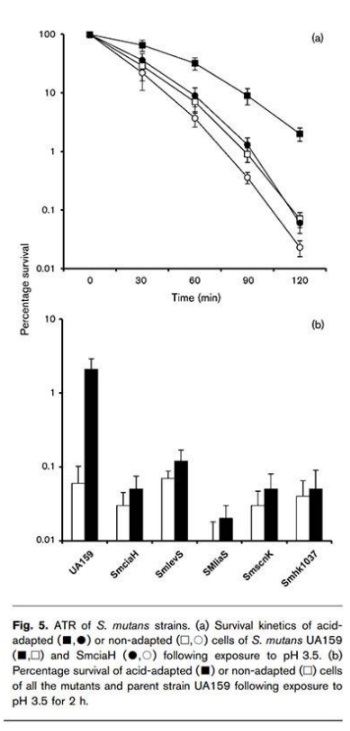
J, Ling J, Li YH. Global transcriptional analysis of acid-inducible genes in Streptococcus
mutans: multiple two-component systems involved in acid adaptation. Microbiology (Reading).
2009 Oct;155(Pt 10):3322-3332. doi: 10.1099/mic.0.031591-0. Epub 2009 Jul 16. PMID:19608608.